Yangchan (阳产) is the odd one out in Huizhou. Where almost every other village in this part of Anhui is whitewashed walls, grey tiles and stepped horse-head gables, Yangchan is yellow earth and dark tile: 367 rammed-earth houses stacked on a slope, with no whitewash and no gables at all. It is the largest and best-preserved earth-house village in southern Anhui, and locals call it the “Potala Palace of Huizhou” for the way the buildings climb the hillside.
The village name describes the terrain directly: “Yang” means facing the sun, and “chan” in the local dialect means steep.
On-Site Video Record
A continuous first-person walk up through Yangchan: stone stairs between earth walls, the lanes that switchback up the slope, and the courtyards where people still live. Natural sound only.
If the player does not load, watch it directly on YouTube.
Getting There
Yangchan belongs to Shendu township in She County, six kilometres from Shendu town and close to the Xin’an River. The last stretch is a single-lane mountain road. Private cars are not permitted, so you park at the visitor centre at the bottom and take the village shuttle (about CNY 28-30 return, 20 minutes of very committed driving). Or walk up on the stone stairs: about 30 minutes at a steady pace.
By public transport: bus or car from She County town to Shendu (about an hour, CNY 12), then a local minibus or the shuttle up the mountain.
Why the Houses Look Like This
The village sits at around 800 metres, on a slope with almost no flat ground. Everything was built from what was within reach: stone footings quarried locally, walls rammed from red-earth soil mixed with bamboo strips, pine branches and lime, timber beams from the surrounding forest, and grey tile roofs.
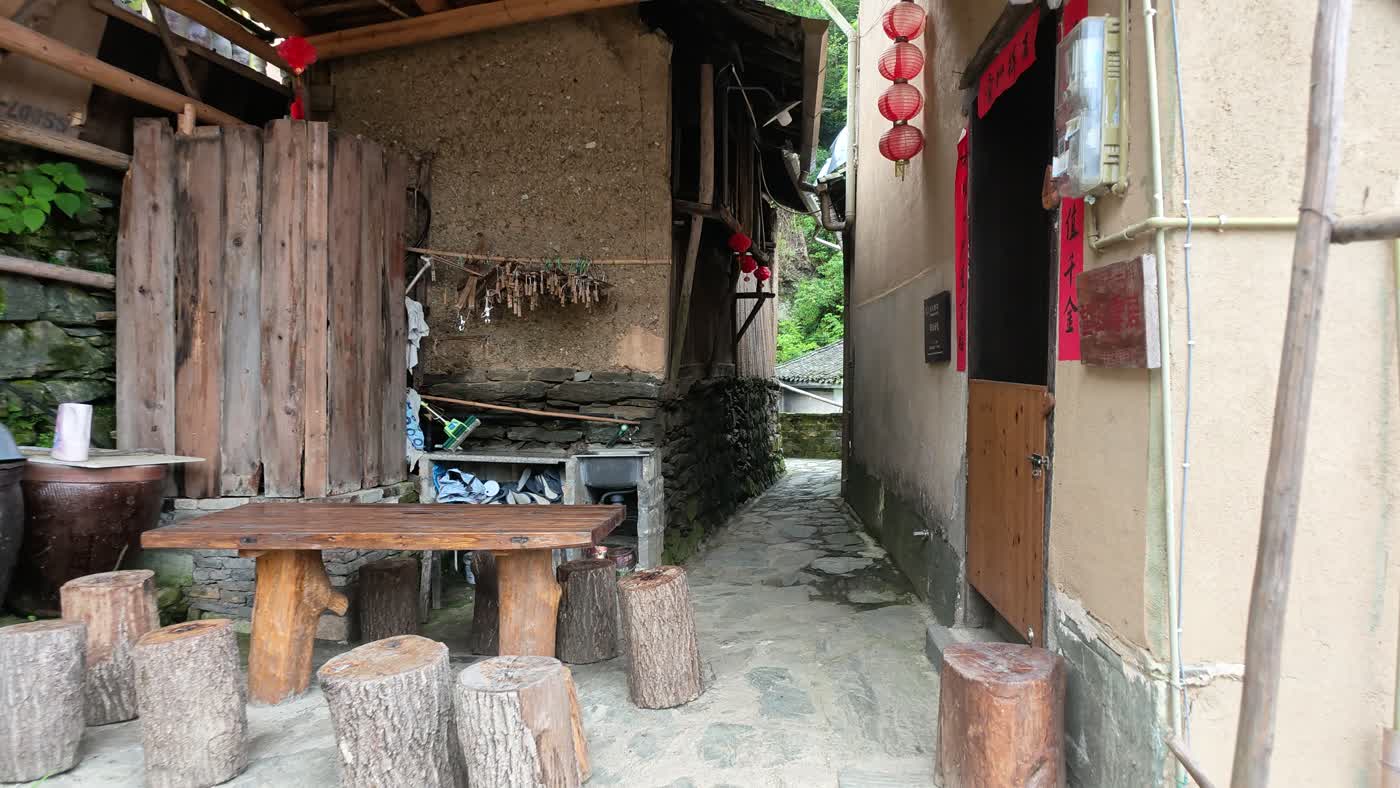
Walls are thick, windows are small, and doors are low, which keeps the houses cool in summer and warm in winter, and made them hard to break into. Almost nothing is decorated. There are no carved lintels, no painted gatehouses, no ancestral hall: Yangchan never produced a rich merchant or an official, so the village is a straight record of subsistence architecture.
The Walk
You enter at the bottom and go up. That is the whole route: stone stairs, lanes, more stairs, and courtyards stacked one above another all the way up the slope.
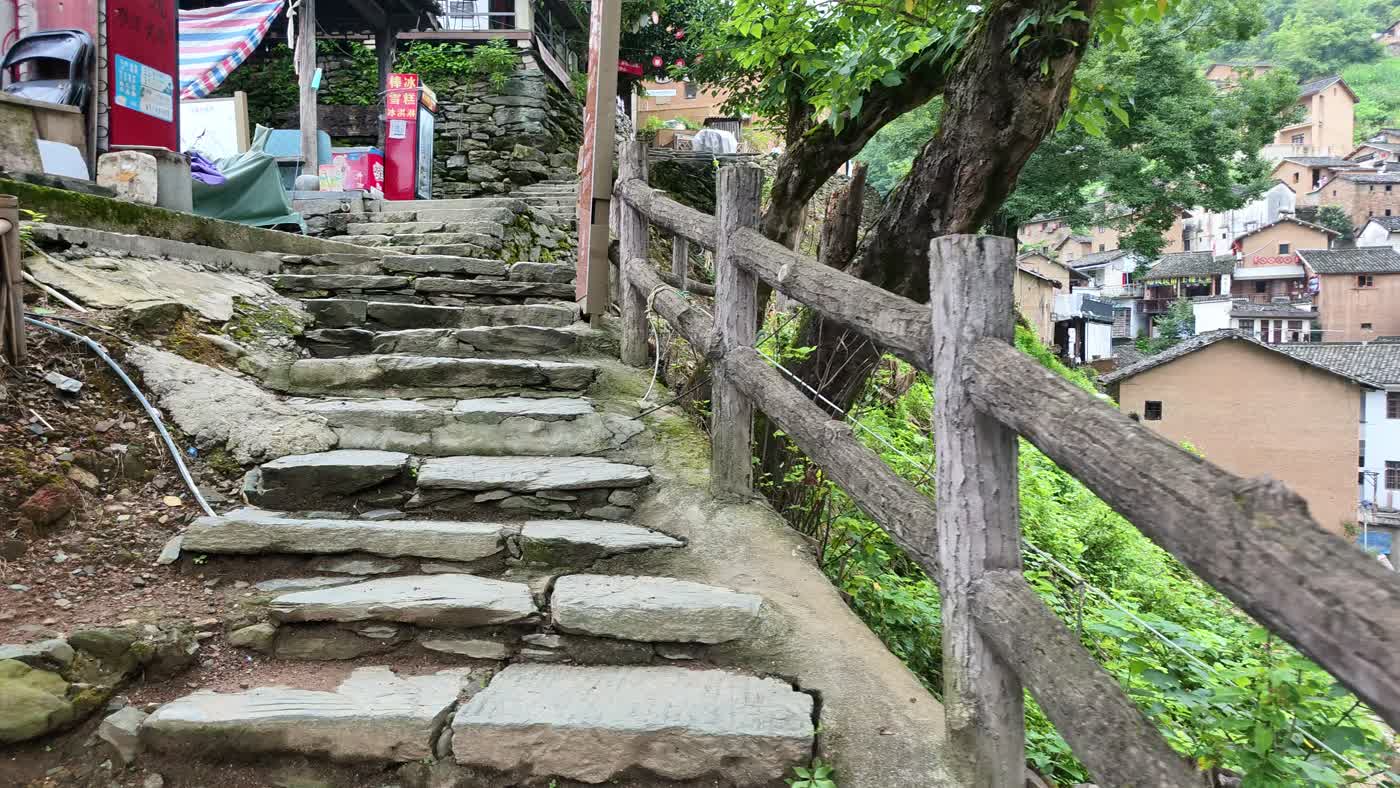
The houses are three storeys as a rule: animals and tools at ground level, kitchen and living space in the middle, bedrooms on top. Lanes are narrow and unpaved in places, and the vertical difference from the lowest house to the highest is about 50 metres. There are no flat streets here, only stone stairs linking the terraces.
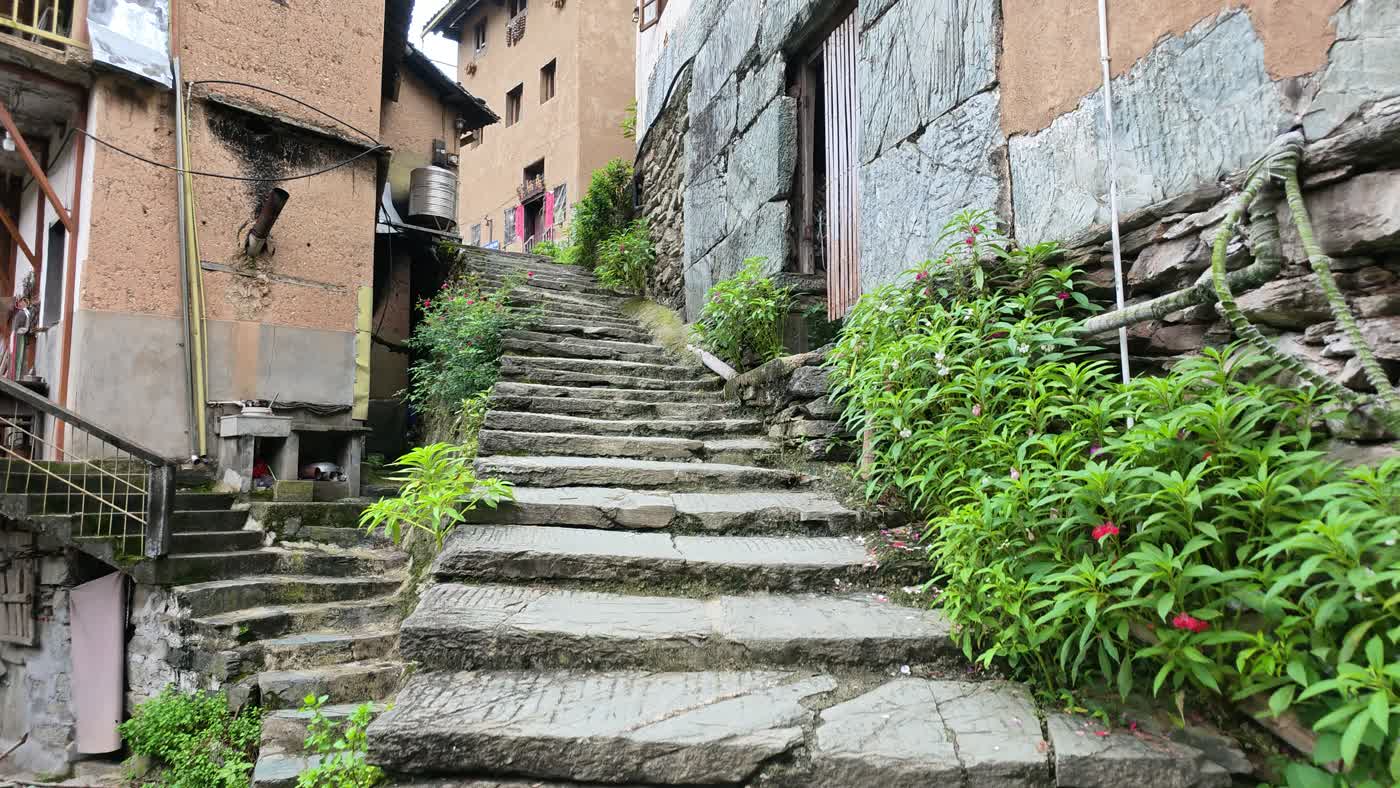
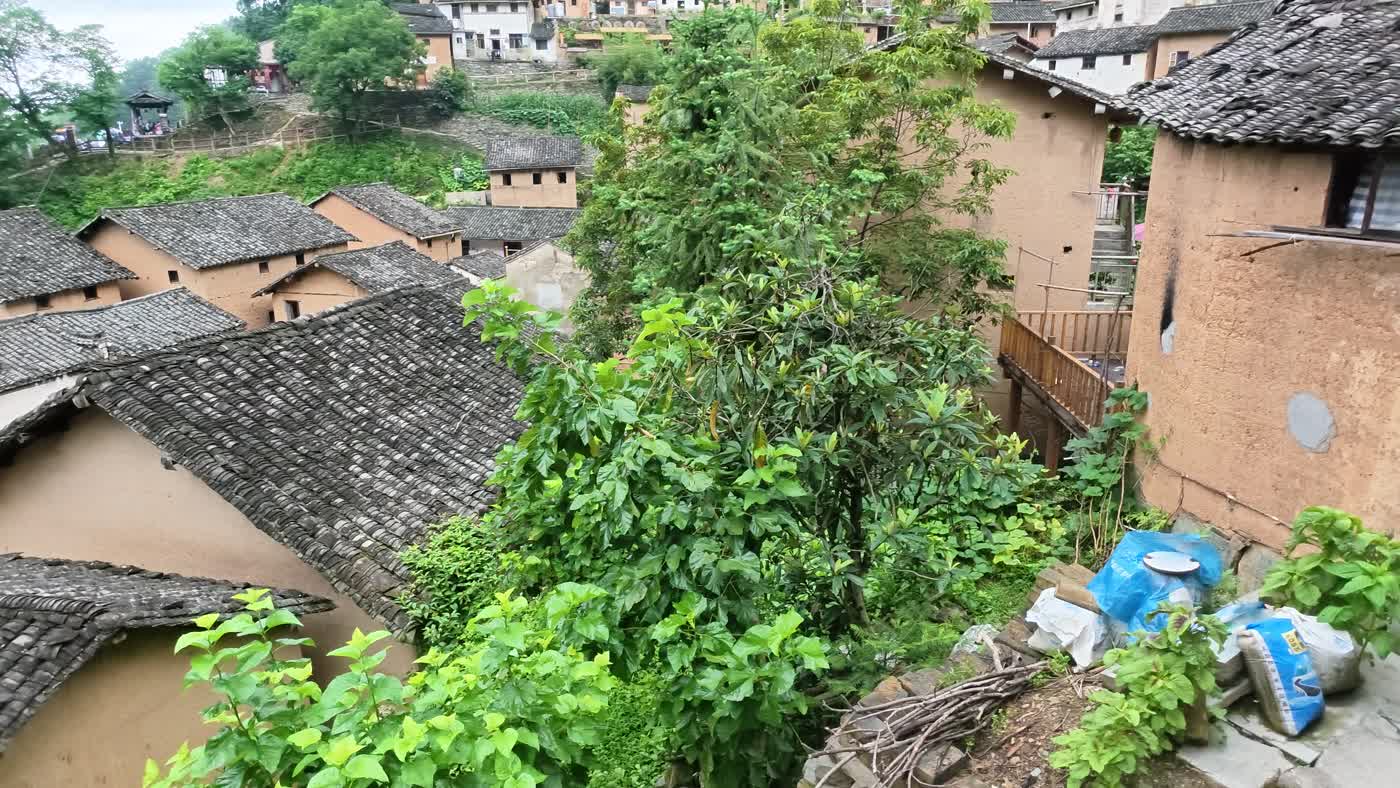
Landmarks worth finding: the “Pentagon” house, built to fit an awkward five-sided plot; the “twin” house with two ridges because the facade was too wide for one; the Hundred-Step Ladder (百步云梯) climbing between houses; and the old primary school terrace, where villagers still demonstrate rammed-earth building.
Water: The Shuidong System
On a dry ridge at 800 metres, water is the real engineering problem. The village solved it with shuidong (水垌): circular stone-lined cisterns built directly over springs, four of them, positioned where the flow was strongest. Together they were sized to supply up to 3,000 people, and they still supply the houses today: cooking, washing, vegetables.
Autumn: The Drying Season
Yangchan is at its most photographed from mid-October to late November, when every flat surface, from roof terraces and balconies to courtyard edges and bamboo trays on stone walls, is covered with drying chillies, corn, pumpkin, and persimmons. Yellow walls, red and gold produce, dark tiles: it is the image the village is known for.
Spring is the other good window, when rapeseed flowers come out on the terraces below the village.
What It Is Like Now
Yangchan is a fully set-up scenic village: cafes, shops, a supermarket, guesthouses and restaurants are all inside. At the same time 186 households still live here, most of them elderly, and the lanes still smell of woodsmoke.
That combination is rare and slightly fragile: it is exactly the kind of place that changes quickly once it becomes famous, and it is already on the way.
Is It Worth Visiting
Yes. Yangchan is one of the few villages in the region that looks like nothing else. If you have already seen the white-wall villages (Hongcun, Xidi, Zhaji), Yangchan is the corrective: same culture, completely different material logic.
Be realistic about the access: the shuttle ride is not for the nervous, the stairs are steep, and there is nowhere flat to rest. It is unsuitable for people with mobility issues, and crowded at the height of the drying season.
Practical Information
| Item | Details |
|---|---|
| Location | Yangchan village, Shendu township, She County, Huangshan, Anhui, 6 km from Shendu and near the Xin’an River |
| Type | Rammed-earth village on a steep slope; 367 earth houses, the largest such group in southern Anhui |
| Height | About 50 m of vertical difference inside the village; the site sits around 800 m above sea level |
| Tickets | Entry to the village is free; a shuttle bus from the car park costs about CNY 28-30 return |
| Access rule | Private cars are not allowed up the mountain road; you take the shuttle or walk |
| Best season | Mid-October to late November for the autumn drying (晒秋); March-April for rapeseed |
| Time needed | 2-4 hours; a night if you want the dawn cloud sea |
| Facilities | Cafes, shops, a supermarket, guesthouses and restaurants |
Visiting Tips
- Park at the visitor centre and take the shuttle: driving up is not allowed and the road is single-lane.
- Come for the drying season (mid-October to late November) if photography is the point, or early morning for cloud in the valley.
- Wear shoes with grip: everything is stone stairs, and they are polished and wet in autumn.
- You do not need to carry food or water. There are shops, a supermarket, cafes and restaurants in the village.
- Ask before photographing inside courtyards; people live here year round.
- If you want the dawn view, stay one night: there are about a dozen guesthouses inside the village.
Yangchan pairs well with Shendu and the Xin’an River boat route, and with the hillside villages of She County. See Wancun for the whitewashed version of the same slope.
The waterfall-and-cliff walk above Zaotai is in the next township, and Zhaji is the valley equivalent of this slope.
Everything here comes from a single visit, cross-checked against public records. Shuttle prices, guesthouse numbers and access rules change, so confirm locally before travelling.
Down in Zhejiang there is a similar stone-built village emptying out more slowly: Shanxiabao in Wuyi county, where about sixty people still live among thirty-one Qing-era houses.