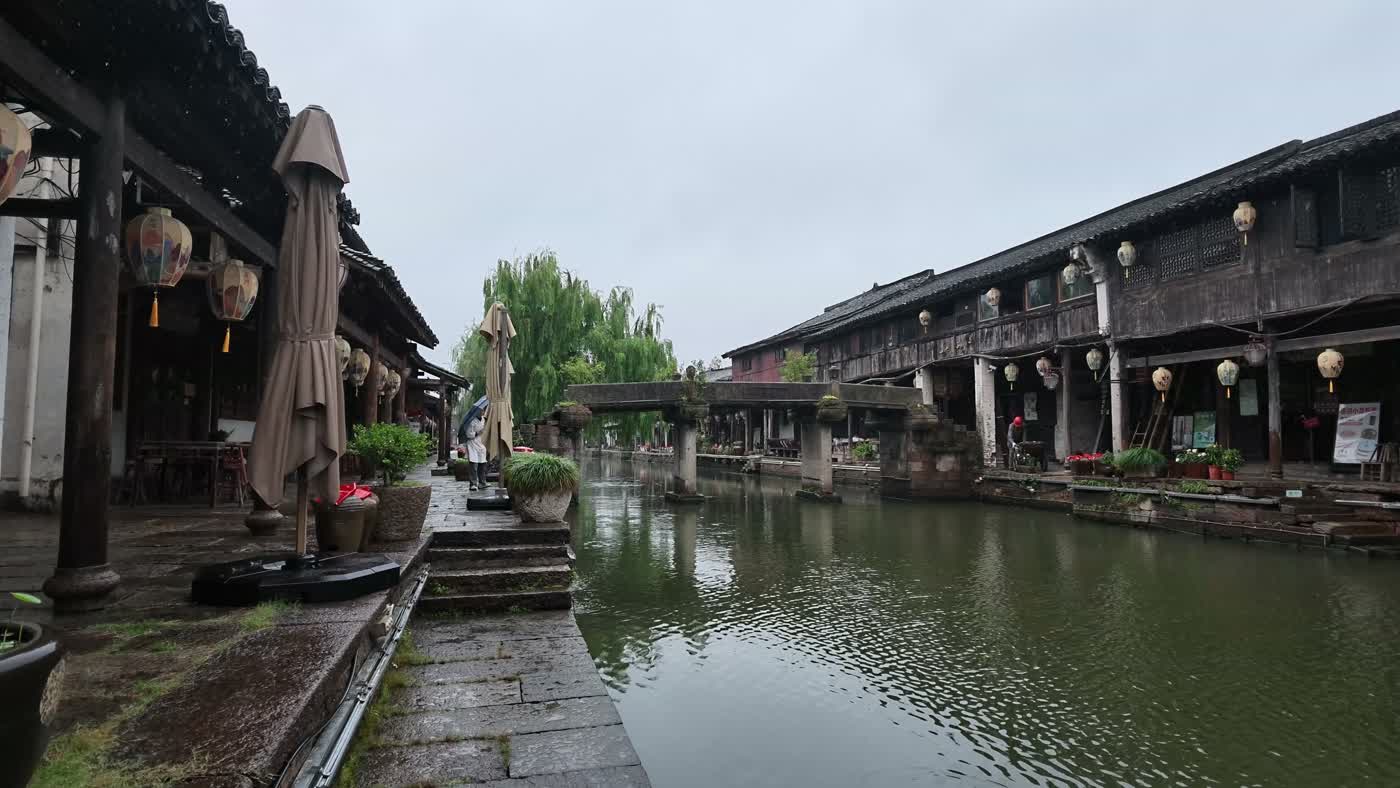
Dongpu is where Shaoxing’s rice wine comes from: a canal town on the edge of the city that has been brewing for more than 1,600 years. The old saying is blunt about it: “Rice wine goes everywhere under heaven, but Dongpu’s wine is the best.”
Most visitors come for an afternoon and photograph the jar walls. Come on a rainy weekday instead and you get something better: wet stone, steam from the workshops, lanterns switched on early, and almost nobody in the lanes. This walk was filmed in exactly those conditions.
On-Site Video Record
A continuous first-person walk through Dongpu in the rain, from the canal-side arcades into the back lanes and past the wine workshops. Natural sound only: rain, water and the odd bicycle bell.
If the player does not load, watch it directly on YouTube.
Where It Is and How to Get There
Dongpu sits in Yuecheng District, Shaoxing, about 8 kilometers west of the old city centre, close enough that this is a metro trip rather than a day expedition. Take Shaoxing Metro Line 1 to Huangjiu Xiaozhen (黄酒小镇) station, leave by exit E, and walk 5-10 minutes to the canal. Bus 108 also stops at Dongpu station. By car, navigate to the north gate; parking is free.
Entry to the streets is free, which makes Dongpu a rare thing in the Yangtze Delta: a water town you can wander for hours without buying a ticket.
A Town Built on Wine and Water
The layout is classic Shaoxing: a main canal with stone-revetted banks, covered arcades along one side, single-arch bridges at intervals, and whitewashed houses pressed against the water. What makes it specific to Dongpu is the wine. Jars stand in rows along walls, stacked in pyramids in courtyards, and hung with red cloth where they are sealed.
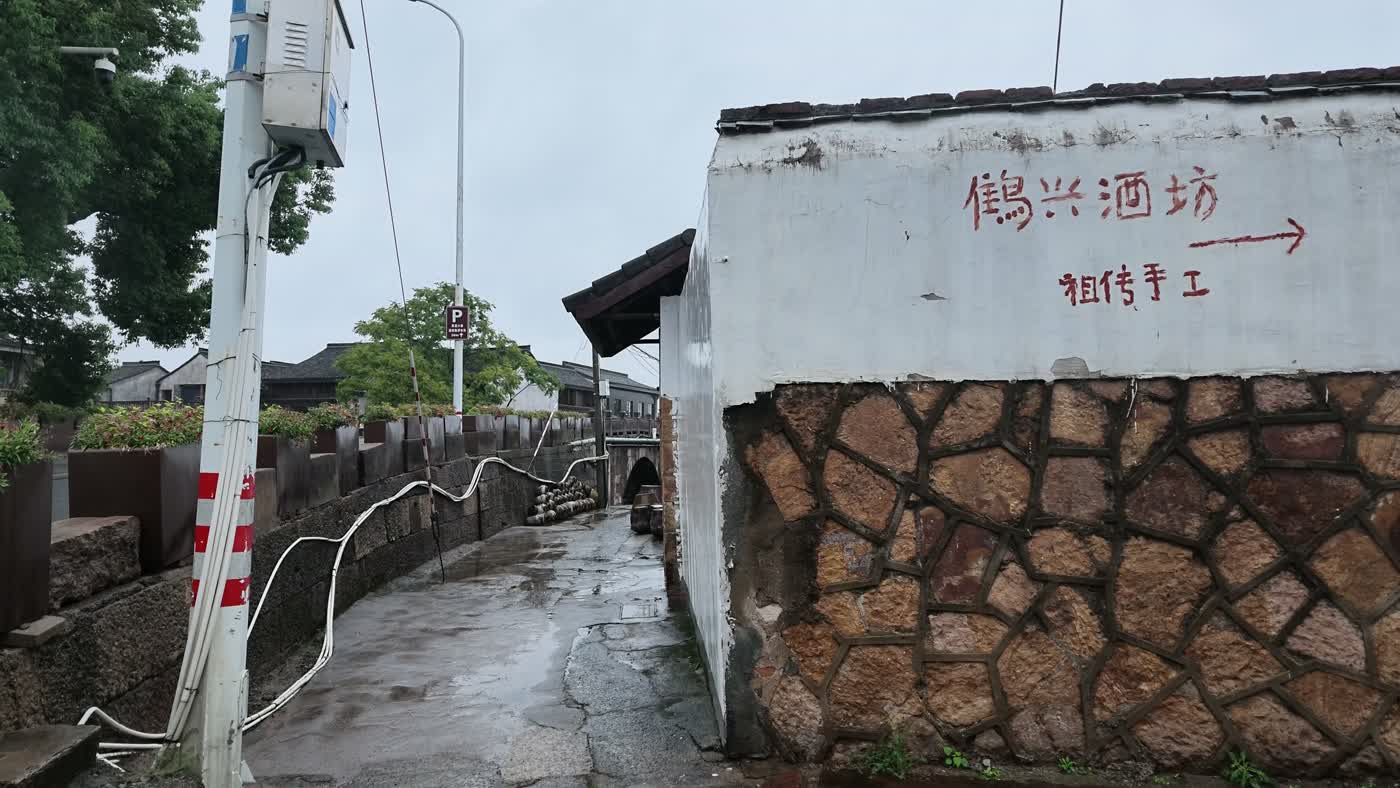
The water matters as much as the grain. Brewers say the secret is that the water of Jian Lake drains into Dongpu, filtered through the thirty-six streams of the Kuaiji Mountains, soft enough to make a wine that tastes of the valley rather than the factory.
The Wine Trail
A sensible route runs from the canal into the old quarter:
- Rice Wine Culture Hall and the vessel museum: free entry, with tastings of three- and five-year wine; the jar wall outside is the town’s most photographed object.
- Yueniang workshop / Yunji Changji distillery: working traditional breweries where you can watch the full cycle: soaking rice, steaming it, pitching the starter, opening the mash.
- Jiuan Yanglong Bureau (久安洋龙局): a Qing-dynasty fire station, small and almost empty, with hand-pumped engines and buckets.
- Xingfu Hou Changwang Temple (兴福侯昌王庙): a family shrine that was later promoted to an imperial ritual site.
Bridges and Lanes
Dongpu is also a bridge town. Dachuan Bridge, Xin Bridge, Mayuan Bridge, Xixiang Bridge and Silong Bridge are all within a short walk of each other, and each one frames the canal differently. The riverside path on the far bank is the quiet side: flat stone slabs, low walls, houses with their shutters closed.
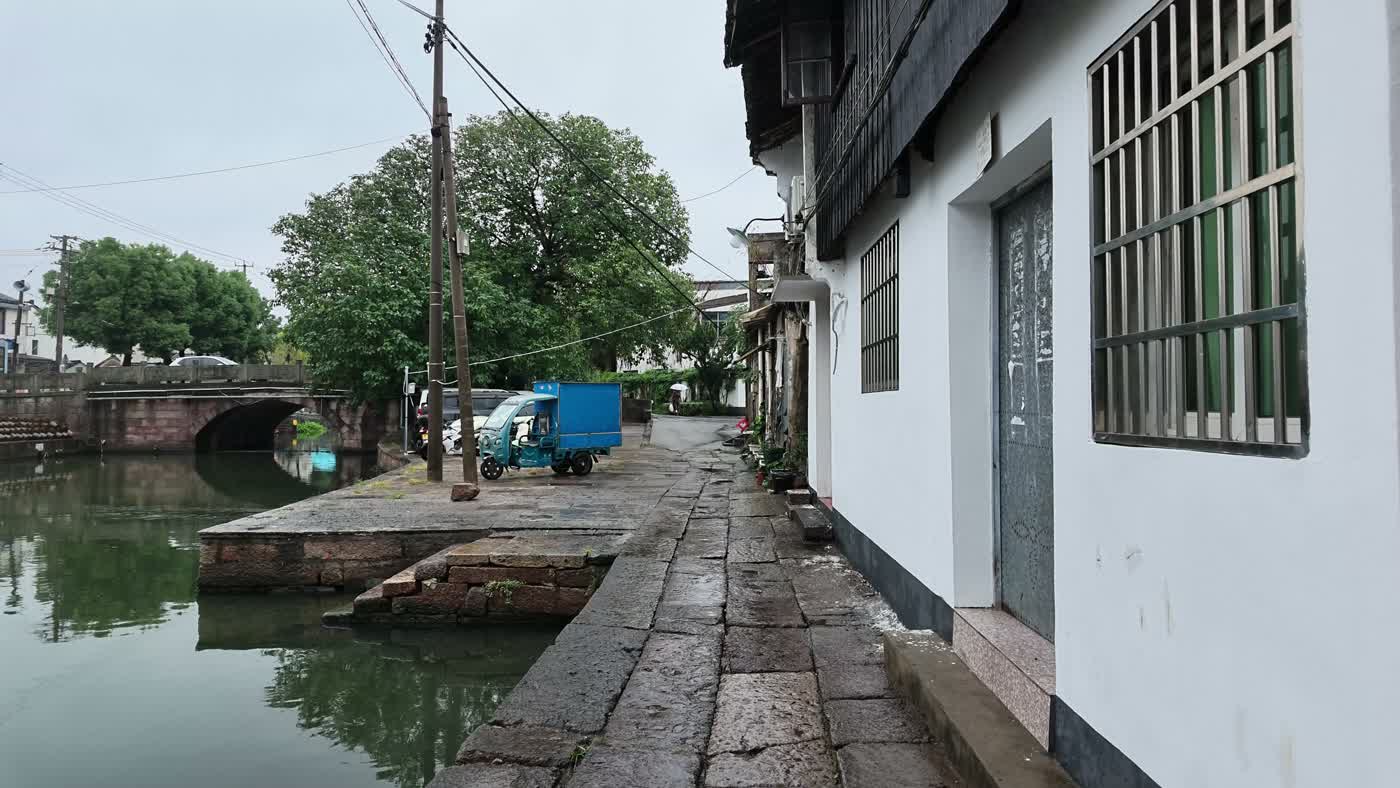
Walk it slowly. The lanes are short, often ending at a step down to the water, and the good photographs are usually behind you rather than ahead.
A Town of Notable People
Dongpu is also the hometown of Xu Xilin, the late-Qing revolutionary who was assassinated after a failed uprising in 1907; Sun Yat-sen wrote a couplet in his memory. His former residence, a Qing-dynasty gatehouse compound, is a National Key Cultural Relics Protection Unit and is free to visit. The poet He Zhizhang and the Song poet Lu You are also claimed by the town.
Rain, Steam and Lanterns
Dongpu is at its best in bad weather. When it rains, the arcades become the only dry route through the town, the stone turns dark, and the workshops vent steam into the lanes. Lanterns along the covered walkway come on early, and the canal doubles everything.
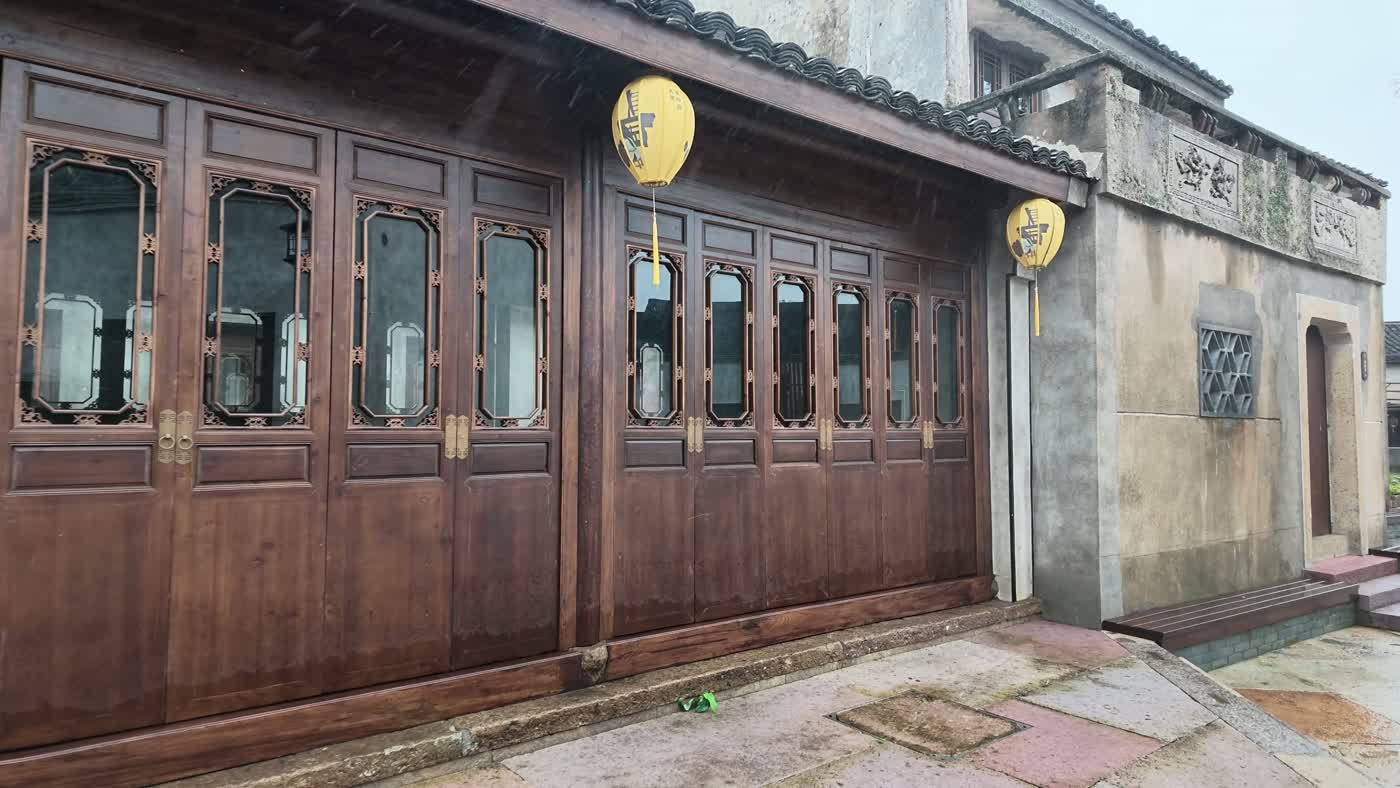
On Friday to Sunday evenings there is a light-and-water show on the canal and a small night market. It is modest by big-ticket standards, but it suits the scale of the town.
Eating and Drinking
The local menu is wine with everything: rice-wine ice lollies, rice-wine milk tea, fermented rice buns, drunken shrimp and crab, pork braised in rice wine, and bowls of fennel beans to go with a warm cup. Buy a bottle of unfiltered wine to take home; it is cheaper here than anywhere in the city.
Is It Worth Visiting
Yes, if you want an unpolished Shaoxing water town with a specific culture attached, free entry, and metro access. It is not a preserved Ming-Qing village like Zhaji, and parts of the quarter are restored or newly built; but the wine trade is real, the residents are real, and on a wet weekday the atmosphere is hard to beat.
Skip it if you want a fully staged historic district with costumed performers and a single ticketed route. Dongpu is looser than that, and half its charm is in the empty lanes.
Practical Information
| Item | Details |
|---|---|
| Location | Dongpu (黄酒小镇 / Huangjiu Xiaozhen), Yuecheng District, Shaoxing, Zhejiang |
| Type | Water town and rice-wine quarter; free to enter, partly restored, still lived in |
| Why go | Rice-wine workshops, jar walls, stone bridges, Xu Xilin’s former residence |
| Tickets | Free for the streets and most halls; small fee for boat rides, tastings and DIY workshops |
| Getting there | Metro Line 1 to Huangjiu Xiaozhen station, exit E, then a 5-10 minute walk |
| Boat | Wupeng boat around CNY 39 per boat, up to 3 people, about 20 minutes |
| Time needed | 3-4 hours; longer if you join a tasting or workshop |
| Best weather | Rain. The lanes empty out and the wine jars darken in the wet |
Visiting Tips
- Go on a rainy weekday if you can: the town is emptier and the mood is better.
- Start at the canal, work inland, and finish at a riverside teahouse.
- Tastings in the culture hall are free; the workshops charge for DIY sessions.
- Everything takes mobile payment, including the small stalls. You will not need cash.
- The wupeng boat is worth it at dusk, when the lanterns come on.
- Wear shoes with grip: the stone paving is wet and polished by centuries of feet.
Dongpu pairs well with Shaoxing’s old town: Lu Xun’s former residence, Shen Garden and the wine shops along Cangqiao Straight Street are all a short metro ride away. Anchang, half an hour north-west in Keqiao, is the other Shaoxing town worth a day: 1,747 metres of covered street, seventeen stone bridges, and a sauce yard working since 1892.
For a bigger, newer water town there is Puyuan an hour north by car; for a Ming-Qing village instead, try Zhaji.
Half an hour east of here, Yanguan in Haining is a different proposition: a rebuilt walled town with a tide outside the gate and resort prices inside.
Written from an on-site visit and public information. Opening hours, boat prices and show times change, so confirm locally before travelling.
For a mountain valley instead of a canal, Shanxiabao in Wuyi county is a two-hour drive south: cobbled lanes, a hall from 1741, and about sixty residents left.