Anchang is a market town on the old canal that runs east from Shaoxing towards Ningbo, about fifteen kilometres north-west of the city. Its single street follows the water for 1,747 metres, and almost all of one side sits under a continuous timber roof. You can walk the entire length in heavy rain and stay dry.
That roof is why the town still reads as a town rather than a set. Under it people keep shops, gut fish, dry laundry and sit out the afternoon. Very little of what you walk past was built for visitors.
On-Site Video Record
One continuous walk, filmed on a weekday in early September: along the corridor, across the bridges, then into the lanes behind the houses. Only the sound of the street.
If the embed fails, the original is on YouTube.
Where It Is and How to Get There
Anchang belongs to Keqiao District in Shaoxing, Zhejiang. From Shaoxing North high-speed station it is a fifteen-minute taxi ride of about five kilometres. From the older Shaoxing station allow twenty-five minutes.
Buses 805, 806, 815 and 816 stop at Anchang Guzhen, which is the main entrance. Metro Line 1 to Yaquan plus a short taxi also works. By car it is roughly an hour from Hangzhou, with parking at the entrance for around CNY 10.
A Name That Came Out of a Rebellion
The town was called Changle until the last years of the Tang dynasty. In 896 Qian Liu, later the first king of Wuyue, was sent to put down the revolt of Dong Chang and camped here. Once it was over the place was renamed Anchang, meaning peace and prosperity, and the name stuck for eleven centuries.
The street itself is younger than the name. It was laid out between the Chenghua and Hongzhi reigns of the Ming, running from Gao Bridge in the east to Qingdun Bridge in the west, and paved with local slate.
The Roof Over the Street
This is the thing to understand before you arrive. The corridor is not decoration. It is a working piece of infrastructure, built so that trade could continue through the wet half of the year. The upper floors of the shop buildings project over the walkway on timber posts, which is why the street feels like a long room with a canal attached.
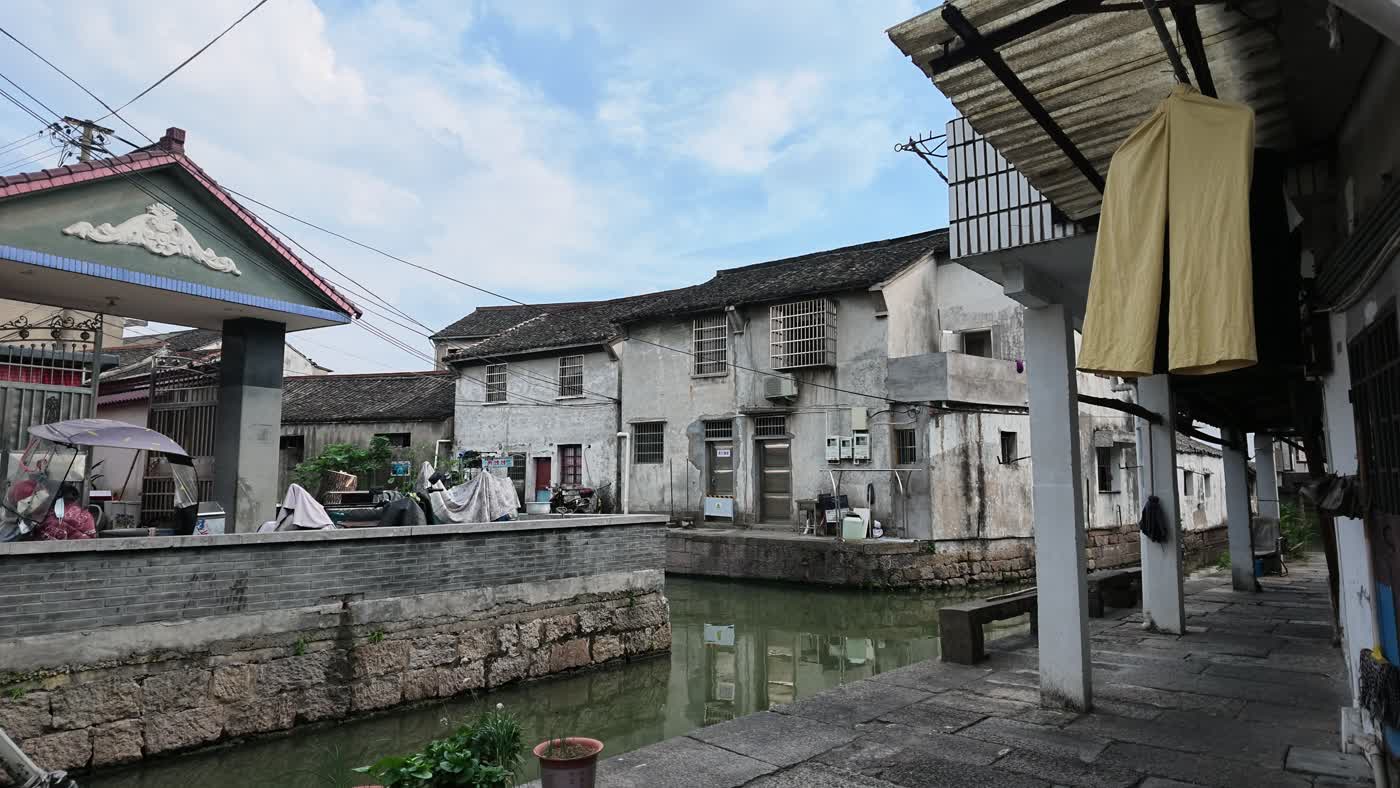
Local people put it in four characters: no sun overhead, no wet shoes. Walk a few hundred metres under the roof and you see the daily routine of the town unfold along the water.
One River, Two Banks
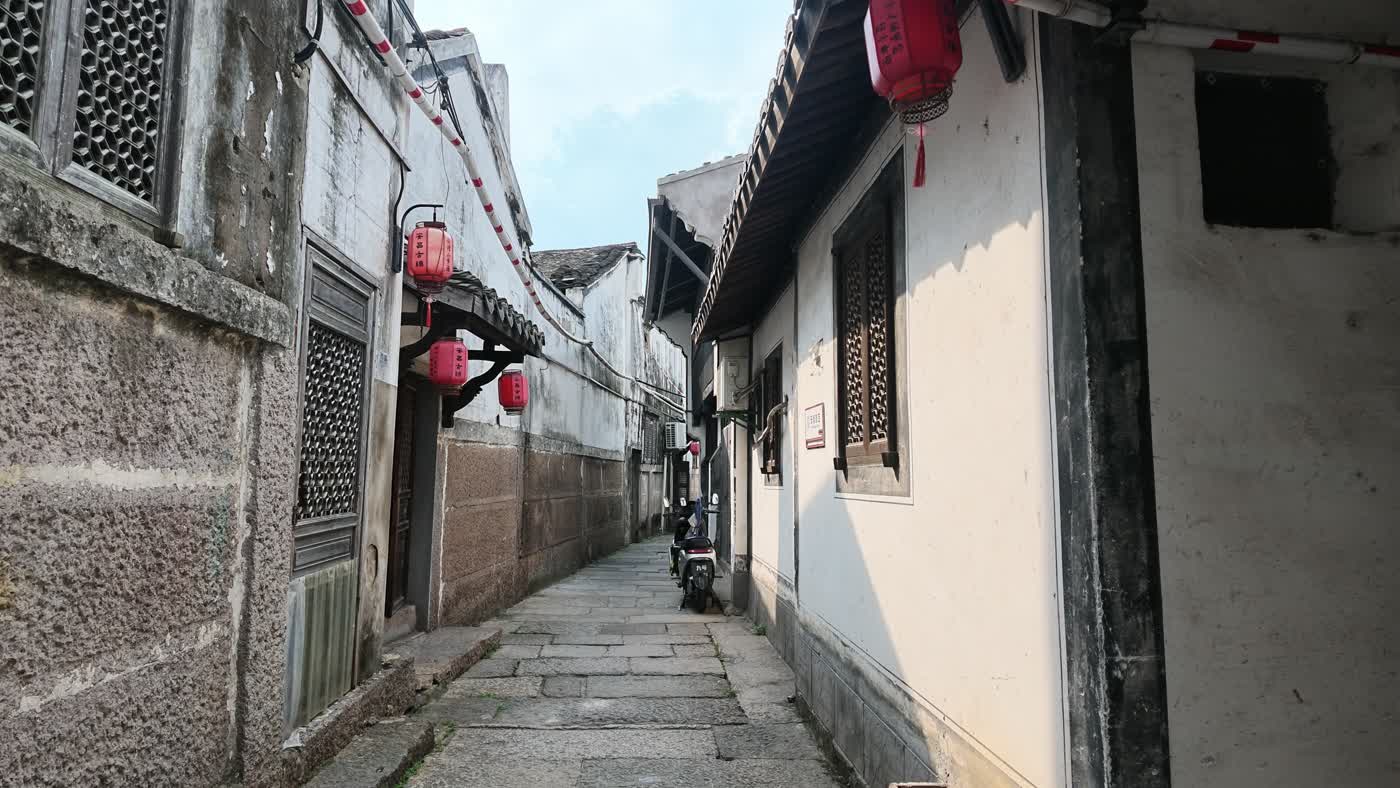
One bank is trade: shops, workshops, sauce, cloth, snacks, a barber, a shop selling nothing but rope. The other bank is domestic, and behind it the town turns into a knot of narrow lanes where the paving runs between walls two people wide.
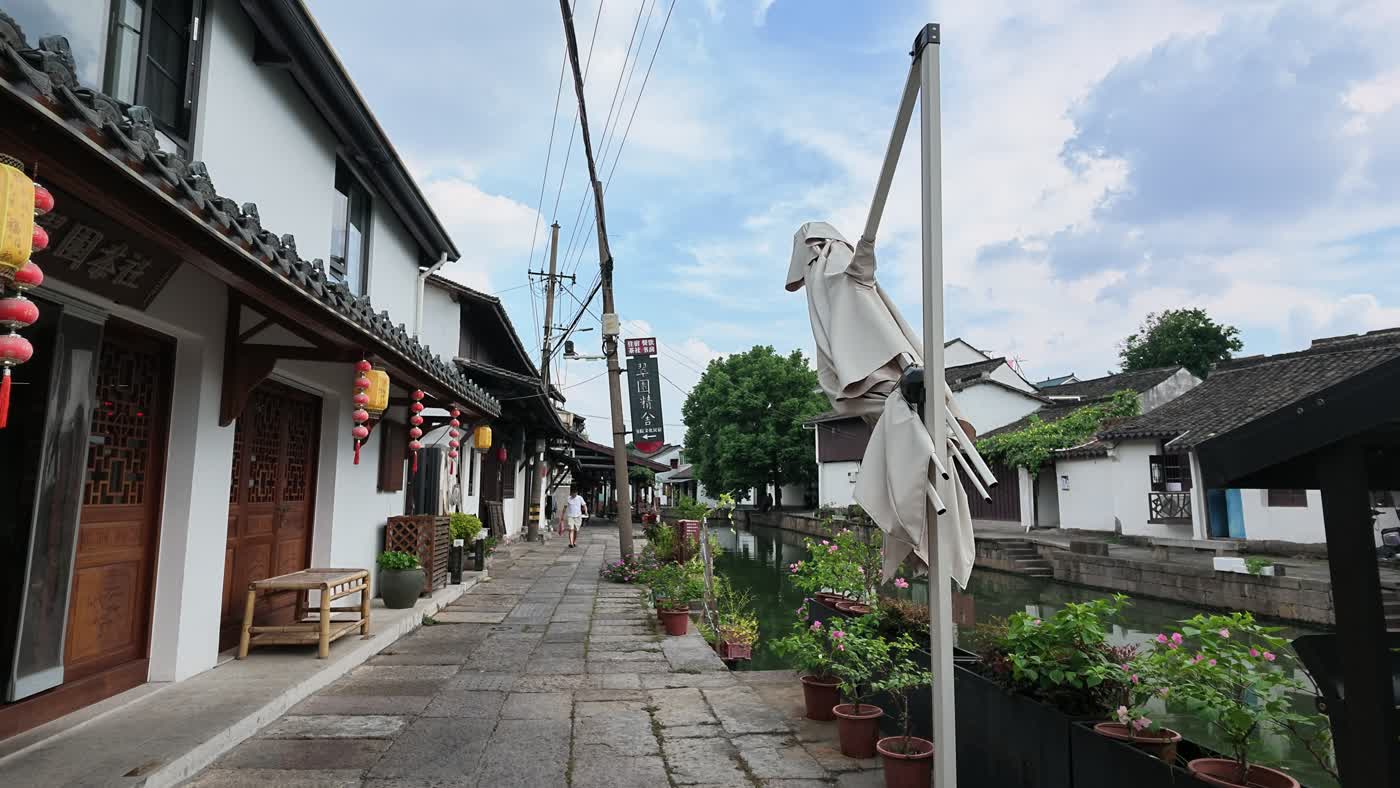
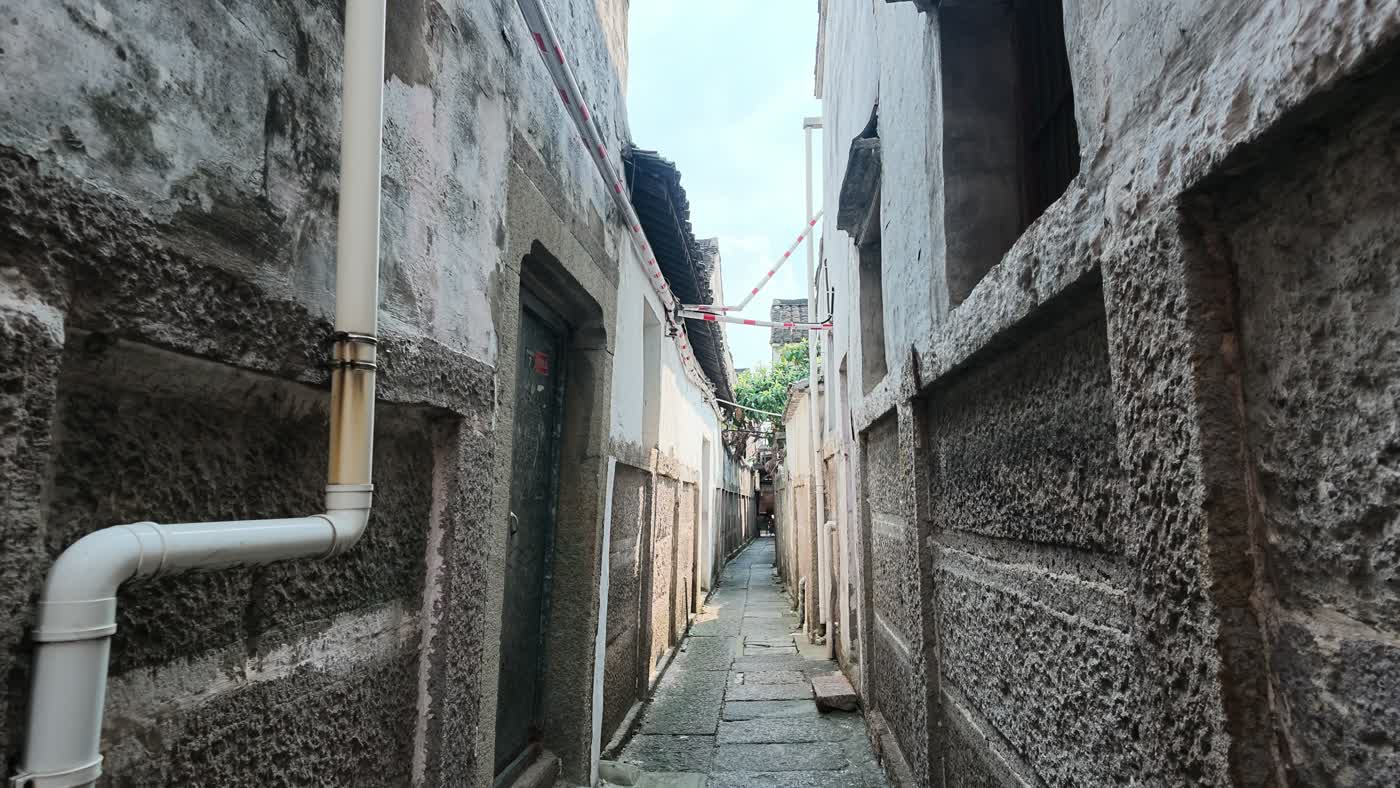
After walking the main canal, turn into the back lanes where everyday residential life goes on quietly. In one of them the walls are roughcast stone blocks on both sides, the paving is a single line of slabs, and the sky is a strip.
Seventeen Bridges
The old couplet for the town counts them: a thousand houses on green water, seventeen bridges like rainbows across the river. They are a mix of arch, beam and eight-character forms, most of them Ming and Qing.
Three carry the town’s rituals. Fulu, Wan’an and Ruyi sit close together, and a bride in the old wedding custom walked all three in one go, for fortune, safety and things going as wished. Anchang Bridge carries a roofed corridor over three arches, which makes it a building as much as a crossing. Guangji Bridge, from the Ming, has lions on the balustrade worn down to soft shapes.
The Sauce Yards
Anchang’s other economy was sauce. Renchang Jiangyuan was founded in 1892, in the eighteenth year of the Guangxu reign, and is the main inheritor of Shaoxing’s traditional soy sauce brewing technique, which is on the national intangible heritage list.
The yard is the sight: hundreds of clay vats standing in rows under woven bamboo lids, fermenting for at least 180 days of sun and night dew. It is free to walk in, and it smells of exactly what it is. The brewery appeared in the documentary series A Bite of China, which is why you will see it on every list.
The Hometown of the Yamen Secretaries
For two dynasties Anchang produced shiye, the private advisers who drafted documents, handled lawsuits and effectively ran county government for officials who had passed the exams but not learned the job. The saying goes: no yamen without a Shaoxing man, and no office without an Anchang man.
The Shiye Hall is the only museum in China devoted to them, housed in a Qing dynasty gatehouse courtyard. Case files, contracts, letters and the furnished office of a working adviser are all there. It is included in the combined ticket.
What September Actually Looks Like
Most photographs of Anchang are taken in the twelfth lunar month, when the corridor disappears behind strings of air-dried sausage and pressed duck for the winter festival. Almost every article you will read was written from those pictures.
In early September none of that is there. The hooks are bare, the corridor is in deep shade, and the only things hanging are laundry and a few paper lanterns. The street is quiet enough to hear a bicycle freewheel for a hundred metres.
This is not a lesser version of the town. It is the town on a normal day, which is the thing the winter photographs cannot show you. Come in September for the architecture and the lanes; come in the twelfth month for the food and the noise.
What to Eat
Anchang sausage is the local benchmark: pork, soy, rice wine, air-dried rather than smoked, sold by the string and vacuum-packed to travel. Pressed duck is the other one, darker and saltier.
Along the corridor you will find hand-pulled sugar (che bai tang), wontons, fermented rice buns, yellow wine ice lollies and small fried fish straight out of the wok. Sit at one of the canal-side tables with a plate of sauced meats and a cup of warm yellow wine to watch the boats pass.
Is It Worth Visiting
Yes, if you want a water town where the street is free, the shops are for residents, and the main attraction is a roof. Anchang is the least staged of the Shaoxing towns, and the corridor gives it a shape you will not find elsewhere in the region.
Think twice if you need a ticket gate, a night show and a curated route. There is almost no signage in English, the museums are modest, and on a wet weekday some of the shops simply stay shut.
Practical Information
| Item | Details |
|---|---|
| Location | Anchang, Keqiao District, Shaoxing, Zhejiang, on the old Hangzhou-Ningbo canal |
| Street | 1,747 metres along the water, mostly covered by a timber corridor |
| Bridges | Seventeen stone bridges; Fulu, Wan’an and Ruyi are the three a bride once had to cross |
| Entry | The street is free and open around the clock. The museums need a ticket |
| Museum ticket | About CNY 50 for the six sites (Shiye Hall, Folk Museum, City God Hall, old Bank of China, Suikang Bank, Stone Carving Hall); about CNY 30 concession |
| Museum hours | Roughly 08:00-17:30 in summer, 08:00-17:00 in winter |
| Boat | Wupeng boat about CNY 40-65 per boat, up to 3 people, around 20 minutes |
| Getting there | Shaoxing North station, then 15 minutes by taxi; buses 805/806/815/816 to Anchang Guzhen |
| When to come | Winter for the sausage corridor; early autumn for an empty street |
Visiting Tips
- Walk the full 1,747 metres. The middle section is the busiest; the ends are where it goes quiet.
- Turn off into the lanes behind the houses at least twice. That is where the town is best.
- Buy the museum ticket only if you care about the secretary history. The street alone is enough for most visits.
- Take the boat one way and walk back, rather than returning the way you came.
- Mobile payment works everywhere, including the small stalls, so you will not need cash.
- Come before 9 am or after 3 pm. Coach groups arrive in the middle of the day.
If you want a water town with a ticket gate and a lighting show, Puyuan is about 90 minutes north by car. For a long canal street inside a city, Shantang in Suzhou is 3.7 kilometres end to end and roughly two hours away. For a smaller town built on rice wine, Dongpu is half an hour west in Yuecheng.
For a town built around water rather than around canals, Yanguan in Haining is a walled resort with a river through the middle and the Qiantang tide outside the gate.
Written from a walk along the street in September, with details checked against the Keqiao district government description of the town.